
By JPC Allen
I knew it was coming, and I dreaded it. Since I write my novels in order from beginning to end, I knew I was slowly closing in on the scenes that twisted my stomach when I thought about them.
Why was I dreading those scenes? Because I was confronting some of my deepest fears.
I’ve always hated being accused of something I didn’t do. In elementary school, if the teacher decided I’d misbehaved, and I hadn’t, there wasn’t a thing I could do. Or when one classmate misbehaved, the teacher would ask the other students to report the guilty party. That’s a tall order for a child to snitch on a classmate. Nobody would, especially in front of the other students. So the teacher punished the whole class. I found it so frustrating, and as a seven-year-old, I didn’t have the nerve to argue with an adult. Looking back, it wouldn’t have done me any good anyway. Teachers rarely reverse a discipline. Being unable to defend myself was a helplessness that has stayed with me my whole life.
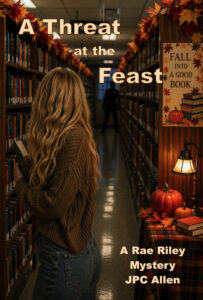
In my YA Christian mystery, A Threat at the Feast, my twenty-year-old sleuth, Rae Riley, investigates the murder of a movie director, who is also the estranged grandfather of her deputy boyfriend, Chris. He comes under suspicion for the crime and then is arrested by the chief of police, who is a rival of Chris’s boss and Rae’s father, Sheriff Walter “Mal” Malinowski.
I didn’t want to write about the trapped feeling Chris would experience when he was unjustly accused. I didn’t want to write how helpless Rae felt as she watched someone she loved face prosecution for something he didn’t do.
 But I also knew if A Threat at the Feast was going to be a novel worth reading, I had to include those scenes. The stakes for Rae and Chris had to be high. So I poured my fears and frustrations into Rae, as if Chris was my boyfriend and I was living the nightmare with him. Because my emotions were genuine, ideas and reactions to the way I set up a scene would pop up into my mind. For example, my research uncovered that few jails in Ohio have a room where a visitor sits on one side of a plexiglass partition, and the inmate sits on the other. All visits are either conducted through a video kiosk at the jail or through a video call from the visitor’s home. I had a deep aversion to that fact, and I gave that aversion to Rae.
Another fact I uncovered was that jail security must be very tight because of the wide variety of offenders who could be incarcerated there. Jail staff must protect the nineteen-year-old who is serving a month for a DUI charge from the person awaiting sentencing for murder. Also, people who can’t make bail and must wait for their trial in jail are under the same restrictions as people who have been convicted of crimes. That seems unfair, and Rae points that out.
If you face writing a scene that cuts deep, don’t be afraid to put it on the page.
If you face writing a scene that cuts deep, don’t be afraid to put it on the page. Despite the emotional grinder I went through to write those scenes, I also knew that such turmoil would make the resolution that much sweeter and deeper, imitating our journey through life. And when a story accurately imitates life, a writer can’t ask for more than that.
 JPC Allen started her writing career in second grade with an homage to Scooby-Doo, and she’s been tracking down mysteries ever since. Her Rae Riley Mysteries series for teens combines faith and family with brain-busting puzzles and has won Selah and ACFW Kidlit awards. She also teaches writing workshops, online and in-person, encouraging every kind of writer to discover the adventure of writing. Coming from a long line of Mountaineers, she’s a lifelong Buckeye and sets all her mysteries in fictional Marlin County, Ohio.
Comments 1
Love your books. Can’t wait to read this one 🙂