
By Joni M. Fisher @authorjonimfisher
You have completed the first draft of a novel or novella. Congratulations! Celebrate this milestone. If you completed writing your first book-length manuscript, you might believe it is ready for publication. Dear sweet summer child, let me hold your hand when I say this: it is not.
At best, it could be ready for publication a year from now. There. There. Stay with me while we explore what happens during that year to polish that manuscript into your brilliant firstborn paper offspring.
Allow two weeks to compose a scene-by-scene summary, a three-page summary, a story timeline, a blurb, give it a title, and a one or two sentence teaser. If you are planning a series, the timeline and scene-by-scene summaries will save you hours of hunting for details needed in subsequent books.
Even if you never outline, it is enormously helpful to summarize each scene and chapter of your manuscript to test the structural integrity of the story. Through this process, you will learn if the point-of-view scenes are balanced. In a romance, HIS point-of-view scenes often equal HER point-of-view scenes. You might also discover that moving a scene will create more suspense, or that the story has a gap to fill. Examining the story, scene by scene, is akin to disassembling an engine to verify each piece does its job well.
During your first edit, examine the structure of your story.
Most scenes will be action scenes that propel the story forward. After a huge setback or loss comes a sequel or reaction scene. Completing a form for each scene (or sequel) serves as an audit. If a scene can be removed from the story without breaking the cause/effect chain, then perhaps it is not needed.
Action Scene
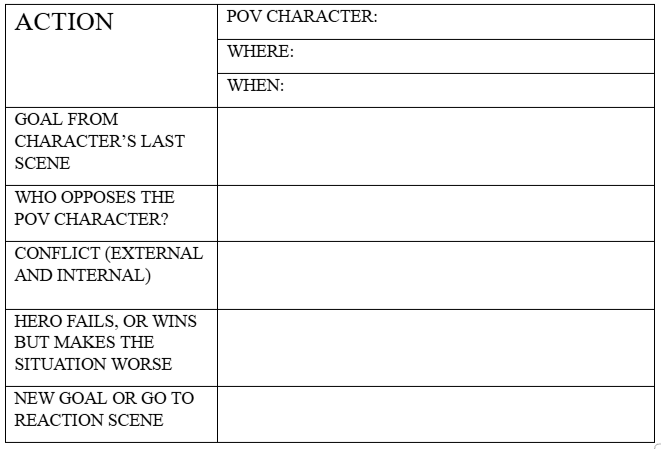
Let’s review these elements from top to bottom and why they matter.
- POV CHARACTER. The entire scene, when told from one point of view, colors the perceptions of all that happens in it. Dive deep into the POV character to experience things from that singular person’s background, vocabulary, and feelings.
- WHERE. Be specific in pinpointing this place. If writing a series, use broad, then close-up details to introduce this place. In subsequent scenes, use a shorthand name like Susan’s apartment.
- WHEN. Be specific with time and date, especially if other scenes fall on the same day. This is your story’s timeline. For a series, the timeline is a separate, easy-to-read list that summarizes each scene. In a crime investigation, this identifies who knew what and when, as well as when a clue is discovered and by whom.
- GOAL FROM CHARACTER’S LAST SCENE. The POV character has a short-term goal. The first scene’s goal tells why the character is there. “Get coffee from shop on way to work.” Each scene will have a short-term goal that leads them to their next scene, and these will grow into the long-term goal of solving the crime, or whatever it is that motivates the character to continue. Each scene connects the cause/effect chain of the story to propel the story forward. Disconnected scenes are tangents to the story.
- WHO OPPOSES THE POV CHARACTER? What obstacles block the POV character from achieving the short-term goal? It could be an enemy, the weather, traffic—name the obstacles. You could also list all the other characters in the scene here for reference.
- CONFLICT (EXTERNAL AND INTERNAL). This is where the events of the scene are summarized. Name the outside and internal conflicts in this scene. Is the conflict social tension, like a family gathering before a major election? Does the conflict escalate during the scene? Does the POV character have a dilemma that creates emotional pain or distress? Who does the POV character interact with in this scene and why? Which details in this scene affect the overall story—a clue discovered, a secret hinted at, a new character introduced? I put vital details in bold, like .357 MAGNUM FOUND.)
- HERO FAILS, OR WINS BUT MAKES THE SITUATION WORSE. The hero’s failures either break him (in a tragedy) or strengthen his resolve for the big success later in the story. What does he learn from his failure? This is growth. A win that makes the situation worse is like winning an argument at the expense of the other person’s dignity.
- NEW GOAL OR GO TO REACTION SCENE. What will the POV character do next because of this event? If this scene is a giant devastating setback for the POV character, then follow it with a Sequel or Reaction Scene.
Reaction Scene
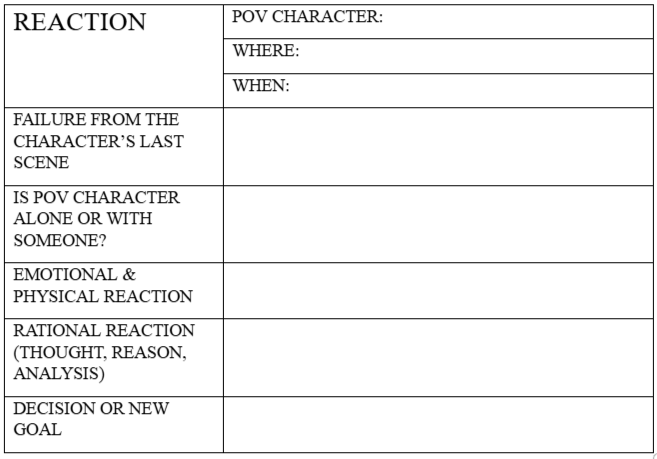
Let’s review the key parts of a reaction or sequel scene.
- FAILURE FROM THE CHARACTER’S LAST SCENE. What has the hero gained or lost in the journey to his goal through this scene?
- IS POV CHARACTER ALONE OR WITH SOMEONE? Does your POV character go off alone or to a best friend or mentor to vent?
- EMOTIONAL & PHYSICAL REACTION. Primal reactions come first. Imagine being punched. Pain comes before other reactions. Explore the feelings and physical sensations associated with the POV character’s failure. Skip this step, and your POV character will seem like a cardboard cutout. A sensitive person will have a longer emotional reaction, perhaps even recalling previous failures as reference.
- RATIONAL REACTION (THOUGHT, REASON, ANALYSIS). Next, the POV character transitions from nurturing emotional and perhaps physical wounds to putting this failure in a wider perspective. A character who owns a failure grows wiser and learns from it. Blaming all failures on others leads to tragedy. Reveal the reasoning of the POV character so the reader understands it.
- DECISION OR NEW GOAL. State the POV character’s decision or new goal. It is a mistake to assume the reader will guess it. OR, you could end the scene with something like, “And then he knew exactly what to do.” This cliffhanger drives the reader to the next chapter.
Then, having audited each scene of your story, identify gaps of time or cause and effect. Are the scenes told in chronological order? Would changing the order of telling them create greater suspense or promote a fact into a discovery?
Which one scene holds the heart of your story? Is it the middle of the story when the hero changes his self-perception? According to James Scott Bell in Write Your Novel From The Middle: A New Approach for Plotters, Pantsers and Everyone in Between, the story flows toward and from this middle scene. Bell argues that in blockbuster movies, the hero discovers or embraces his true identity in the middle of the movie, which empowers him and changes his trajectory.
Do the scenes portray the changes in the hero’s arc? In The Christmas Story, we see Scrooge evolve from penny-pincher to philanthropist as he is forced to see the past, present, and probable future of his life. What is your hero’s arc? If there is no radical change, is this story a slice-of-life? Can you identify each scene that nudges the change in your hero?
Using your scene cards, find the stakes. Do they grow more serious? If not, fix that.
The structural audit is the first edit of your manuscript. You can do it yourself and then share the manuscript with a few close writers for their critique. Or hire a professional to do a developmental edit. I recommend watching Patrick Walsh on YouTube: @publishingpushofficial to learn more about developmental and structural editing. Whichever methods you use, remember to set aside all defensive emotions, shut up, and listen. The critiques are to help your manuscript improve, even though not all critiques are accurate or useful. Accept them with thanks and then sort them out by usefulness, not by how easy they will be to implement.
If you completed writing your first book-length manuscript, you might believe it is ready for publication. Dear sweet summer child, let me hold your hand when I say this, it is not. @authorjonimfisher #writing #writingtips #ACFW
The next rounds of re-vision and editing will be for flow, imagery, and rhythm. The very last edit will be proofreading for grammar, redundancy, and sentence logic. This is a marathon, not a sprint, but you can do it.
 Joni M. Fisher writes contemporary stories featuring friendship, family, faith, and crime. A member of the American Christian Fiction Writers and the Florida Writers Association, she also served on the Southeastern University Arts and Humanities Advisory Board. Her latest book is Guardian of the Galleries, one of six books in the Don’t Blink Twice collection.