
by Linda Dindzans MD
Writers want readers to savor every word—but sometimes our words pile up, rush ahead, and leave no room for reaction or reflection. Yet there are moments when silence is not only desirable but essential.
What do I mean by “silences” in writing?
Anything that makes the reader, the character, or the action slow… pause… stop.
Why learn to write effective silences?
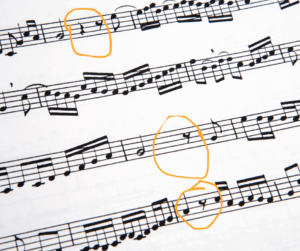 As in music, the rests are part of the rhythm. Silence gives meaning and space.
When used with intention, silence can:
- build tension
- generate anticipation
- give the reader a moment to ponder or recover
- offer a quiet counterpoint to drama
- serve as a metaphor for the silence of the grave
A savvy author chooses how, where, and when to use silence. The best way to evaluate your choices?
Read your work aloud.
Every. Single. Line.
Three Ways to Write Effective Silences
- punctuation
- style and structure
- content
Punctuation 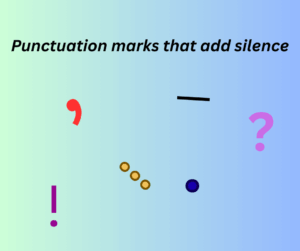
Punctuation creates silences ranging from the briefest pause to a full stop. The writer chooses the length of silence needed.
Comma
A catch-breath—small, sometimes unnoticed, but it changes the rhythm and slows the pace.
Period
A clean, straightforward stop.
Em dash
A longer pause, an abrupt cut, or a sudden intrusion. It draws attention and heightens emotion.
In dialogue, the em dash signals interruption and adds tension.
An interruption from another character implies conflict or urgency.
An interruption from action suggests surprise, danger, or mystery.
Ellipsis (…)
Often a soft fade-out in thought or speech—uncertain, trailing, or incomplete.
Style and Structure
Sentence length
Short sentences quicken pace, heighten tension.
Longer sentences slow the reader, relax the mood.
But exceptions exist:
A breathless, run-on sentence can convey panic.
Paragraph length
Paragraph breaks give the reader a pause—tiny silences that affect readability.
Rhetorical devices
Every writer should study rhetorical devices.
Margie Lawson’s Deep Editing, Rhetorical Devices, and More or the Making Silence BOOM! webinar (margielawson.com) are excellent resources.
These devices add power, texture, and rhythm—and they also shape silence.
 Examples from A Certain Man
(From my twelve-years-in-the-making debut novel, released August 2025.)
Consider how a simple adjective transforms the word silence:
- accusing silence
- eerie silence
- disciplined silence
Try free-associating adjectives A–Z. Some will be odd, but some will be fresh, surprising, and perfect.
Alliteration
Even simple alliteration amplifies silence:
- shimmering silence
- superstitious silence
- A secret simmered in the silence.
Repetition also adds weight:
The growing silence felt heavy.
Heavy with hate.
Heavy with death.
Period-infused sentences
Compare:
Never, ever again.
vs.
Never. Ever. Again.
Both work—but the second creates more space and silence.
White space
White space lets the reader breathe. Consider the impact of a centered, isolated version:
Never. Ever. Again.
Content
Rhetorical questions
Not meant to be answered—they create a contemplative silence.
Should a promise be broken when it becomes difficult to keep?
Cliffhangers
A forced silence at the end of a scene—compelling the reader to turn the page.
From A Certain Man:
Mara knows Samuel was attacked by three men. She returns with help only to find him half-buried in loose soil.
Mara held her breath.
Silence. A far-flung silence. A silence clinging to a shred of hope.
A gasp broke the silence.
And her buried Beloved began to breathe.
Silence narratives
These describe the impact of silence on the POV character.
From A Certain Man:
Jareb stood in his saddle…
No one moved. No one spoke. Even the children were still. The accusing silence stretched.
Not Sabbath-rest silence. Not sepulcher silence.
This silence teemed with temptation—great wealth and great greed.
Samuel studied their faces. Their stances.
He could almost hear the gold coins clink as they counted the reward in their heads.
The Other Silence
And then—
there is another kind of silence.
The silence that looms when words, ideas, and creativity have vanished like morning vapor.
A paralyzing silence.
A prolonged
S––i––l––e––n––c––e.
Writer’s block.
What then? Share your coping techniques.
Which techniques did you notice above?
Please share your thoughts in the comments.
 Linda Dindzans, M.D. is an award winning author with the heart of a healer, offering readers stories of redemption and restoration. Though her compelling characters live in the treacherous world of the Bible, she believes their struggles still speak to hearts today. A Certain Mercy will be released December, 2025. Find Linda on her website at lindadindzans.com, on X: @lindadindzans and Facebook: Linda Dindzans.
Comments 4
Love it. Isn’t the meaning of life found in the silent moments?
I love playing with the sounds of words in silent moments in the manuscript. Great post, Linda!
I wish I’d read your article twenty years ago, when I was trying to understand all that you provided. Even now, it’s a great reminder – a wakeup tool for things I can use but have set aside in my memory. I hope other writers benefit from what you’ve provided.
Nice post! I enjoyed it.