
By Jeffrey Friedel @JeffersonRiede
Yesterday my writing coach returned my manuscript with comments and edits, and within five minutes I discovered an exciting new subplot called “Defensiveness.” Then I briefly considered spinning it off into a companion project titled “Avoidance.” But our discipleship group has been reading Counterfeit Gods by Tim Keller, and it’s been exposing the hidden idols I attach to my work. Keller’s central warning is that idols aren’t usually “bad things,” they’re often good things that become ultimate things, promising the security, significance, or satisfaction only God can give.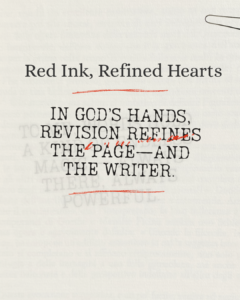
Most of us say we want to grow as writers. We love the idea of improvement in the abstract. But put real comments in the margins, (“This section drags,” “I’m confused,” “Cut this scene”) and suddenly growth feels less like professional development and more like personal attack.
And yet Scripture doesn’t romanticize refinement. It tells the truth: growth can sting. “For the moment all discipline seems painful rather than pleasant, but later it yields the peaceful fruit of righteousness…” (Hebrews 12:11)
That verse isn’t only about spiritual disciplines; it’s about formation. And revision is a kind of formation—of the manuscript, yes, but also of the writer.
This is one reason feedback matters so much. A wise beta reader isn’t trying to wound you; they’re trying to help your story become what it’s meant to be. A good editor isn’t flattening your voice; they’re clearing the brush, so your voice comes through. “Faithful are the wounds of a friend…” (Proverbs 27:6). If we can receive critique as a gift, we’re far more likely to grow.
Keller’s framework helps explain why critique can feel so intense. Often, the feedback isn’t just touching our sentences—it’s touching what we’ve quietly asked writing to do for us.
For writers, those “ultimate things” can show up in familiar ways:
- Pride: “If they don’t love it, what does that say about me?”
- Approval: “I can’t breathe unless the feedback is glowing.”
- Recognition: “If this doesn’t lead somewhere ‘real,’ was it worth it?”
- Career/control: “I need this book to validate the time I’ve invested.”
No wonder an edit letter can spike the pulse. If my identity is tethered to praise, criticism feels like freefall. If I’m craving recognition, silence feels like rejection. If control is the idol, revision feels like loss.
The editing process becomes a mercy when we see it clearly: feedback is not a verdict on our worth. It’s a tool God can use to strengthen our craft and loosen our grip on counterfeit saviors.
That doesn’t mean every note is correct or every suggestion must be followed. But it does mean we can receive feedback without panic and without defensiveness. Sometimes the most spiritual sentence we write during revisions is simply: “They might be right.” Or, “Even if they’re not right, I can still learn.”
Here’s a practical approach that has helped me keep my heart steady while revising:
1. Receive first, react later. Read the notes once, then step away. Pray. Take a walk. Eat something.
2. Look for patterns, not preferences. One comment may be taste. Three comments are often a signal.
3. Bless your readers and editors. They gave time, attention, and honesty—gifts that are increasingly rare.
4. Revise in faith, not fear. The goal isn’t perfection. The goal is faithfulness.
And when your heart starts craving validation, when you want edits to feel like applause, return to the better prayer: “Search me, O God, and know my heart…” (Psalm 139:23). Let the Lord show you what’s really happening beneath your reaction. Let Him replace the thin comfort of
affirmation with the solid comfort of His presence.
So take the notes. Pray first. Revise slowly. And when the red ink pokes at your pride, let it become an invitation to trust the Lord again. Your worth was settled at the cross, not in an edit letter. Write with open hands. Receive feedback with humility. And watch God use revision to refine both the story on the page and the storyteller behind it.
 Jeffrey Friedel (writing as Jefferson Riede) is an Atlanta-based author of Christian thrillers with a technology edge and vivid, far-flung locales. His debut novel, STRONGHOLD, was a semi-finalist in the 2024 ACFW Genesis Contest. His second thriller has just been completed, and a third—focused on quantum computing—is in the works. Visit him at https://jeffersonriede.com/
Comments 4
“Your worth was settled at the cross, not in an edit letter.” Great line! And a great article.
Thanks Pam! It is a truth that is sometimes hard to hold onto.
This is very worthwhile teaching. Feedback is always challenging for me. Your comments have reminded me to keep the main thing/person central to every thing and allow ourselves to be transformed.
Thanks Vera! Initial reactions to feedback can be a challenge for many of us. But when received in the right spirit, feedback can be one of the most important elements of our growth.