
by Leslie DeVooght
Don’t waste a chance to make your writing flourish with weak metaphors or worse,
clichés. As a writer of Southern Fiction, sometimes it’s hard for me to not use one of the tried
and true phrases. I mean “bless your heart” and “she’s as pretty as a peach,” will work in a pinch,
and they do scream southern, but it’s so much more fun and satisfying for your readers if you
create new phrases.
Years ago, I asked my Facebook followers for their favorite Southern Phrases and ended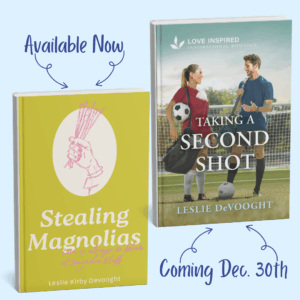
up with three pages of fodder for my stories. Some of the them are so funny and not well known, so occasionally, I’ll slip one in. But recently, I’ve begun using the list as a jumping off point. For example, in my Love Inspired book, Taking a Second Shot, releasing December 30th, I needed to point out something obvious. The characters had just participated in an Easter Egg hunt, so the sassy grandma told the couple, “Y’all couldn’t find the golden egg if the goose laid it on your head.” The original Southern Phrase was “you’re as lost as a possum in a corn field.”
While I love to employ metaphors to add humor and a taste of Southern Culture, I also like to look for opportunities to use figurative language unique to the character’s occupation or hobbies. For example in my novel, Stealing Magnolias, the main character is an interior designer and she says, “let’s not count our throw cushions before we have a couch to put them on.”
Most importantly, create phrases that work for your characters. A hockey player should
only use a metaphor about painting watercolors if he’s also an artist. The wrong metaphor will
take the reader out of the moment and diminish the impact of the phrase. If you write historical,
be especially careful to make sure your figurative language fits the period.
My advice for adding unique and creative metaphors is make this a step in your revision
process. If you try to do it while your writing a first draft, it will slow you down too much or
give you a reason to dive down a rabbit hole, searching for the perfect phrase. I suggest just
using a cliché and adding a note to change it later. I also highly recommend using other people to
help you come up with just the right phrase.
When my character was a military history buff, I asked my husband what battle was an
easy victory, then I used it in my story. When I needed to change, ‘don’t get your knickers in a
twist’ because my editor didn’t want anything related to undergarments in my story, I asked my
Facebook reader’s group. One of my followers suggested “don’t get your apron strings in a
tangle,” which was perfect for my main character who loved to cook, making my story stronger.
While I was editing my most recent story, I made a list of possible subjects specific to my main
character. When I needed a phrase, I checked my list to help me come up with something witty
and fun.
Challenge yourself to create meaningful and witty metaphors to make your stories fun
and engaging. It will make your writing stand out, and add to your readers’ enthusiasm.
 Award-winning author Leslie Kirby DeVooght writes women’s fiction with faith, love, laughter, and a lot of Southern charm. Her stories are inspired by romcoms, coastal Georgia, and fried okra! When Leslie isn’t writing, she’s cheering on her children, and enjoying dates with her husband, who loves that she researches kissing.
Comments 4
Such an interesting post! Thank you, Leslie!
Leslie, this is a helpful post, thank you. LOL, granny’s golden egg statement!
A helpful post. I do try to come up with phrases related to my characters occupations or passions, but it definitely takes more effort.
Thanks, Leslie. I needed this. And I agree that this effort is best done in the rewrites.