
by JPC Allen
 Since 2018, I’ve spent every day with my teen detective Rae Riley. She’s had a cameo in one short story and been featured in another as well as three novels. After working with her for so long, here are four tips for creating an engaging teen detective.
A Reason to be a Teen Detective
It’s better for your teen detective to have a reason for sleuthing besides perpetually tripping over bodies and discovering crimes. Maybe she has a thirst for justice. Or a fascination with true crimes. Maybe he’s just plain nosy.
In the first stories, Rae solves mysteries because she has to. In A Rose from the Ashes, she investigates the murderous attack on her mother when her mom was pregnant with her twenty years ago in the hope of finding her father. In A Shadow on the Snow, someone is leaving Rae threatening notes.
But in the next mysteries, Rae is motivated to involve herself in puzzles because of a deep sense of empathy. She can imagine being in a tough situation and hoping someone would help her because her mom told her about how a nurse guided her to salvation. So when Rae sees someone struggling, she almost can’t stop herself from helping. The great thing about this motivation is that it can be both a strength and weakness for Rae.
A Special Talent for Detecting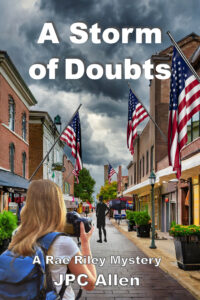
Your teen detective should have some talent or ability or connection that helps them in their investigation. This could be inside knowledge. If a crime is committed at the high school, your teen sleuth knows the people in that setting, especially her classmates, better than the police would. Or the sleuth could look into a cold case and bring a fresh perspective to it. Or the teen is an expert in some field and that skill aids in solving the case.
Rae is a dedicated amateur photographer and hopes to become a professional. This art makes her observant, noticing tiny details, like changes in people’s expressions or breaks in patterns of behaviors or speech.
But despite these special skills, talents, or connections …
A Teen Should Still Act Like a Teen
Readers of teen mysteries already have to suspend their disbelief to buy into a story in which a teen solves a case. As a writer, I don’t want to force readers to throw away their disbelief all together by making Rae the smartest person in the book. I want teen readers to either identify with my teen detective or want to be her best friend. That’s whole lot easier if Rae acts like a regular teen in most situations.
In A Storm of Doubts, Rae’s con man Uncle Troy returns to Marlin County, Ohio. Rae’s dad warns her to stay away from him. When Rae and two of her cousins find Troy beat up outside of a mall, Rae sees her uncle is in no shape to drive and decides to drive him home in his car. That decision leads to a lot of trouble, and Rae’s Uncle Hank tells her she should have called the cops. Rae says:
“But he wasn’t drunk or high.”
“You thought he was a danger behind the wheel,” said Hank. “You can call the cops for something like that.”
“Oh. I – I didn’t know that.” I let the flashlight drop.
I thought that was a believable way for Rae to get into trouble without looking silly or stupid. She simply didn’t know what to do in this situation because she’s only twenty.
But even though Rae should still act her age …
The Teen Detective Must Be the Agent of the Mystery
Rae has to be actively solving the mystery. She has a conversation and draws a conclusion from it, which she tests. She looks for clues. She discusses her theories with her dad or grandmother or cousin. If she wasn’t in the mystery, it would never get solved because her observations and conclusions are the key to the solution.
And–this is a personal peeve of mine–the teen detective should not be kidnapped at the end by the villain and lay helpless until rescuers arrive. I think I know why I find this in teen mysteries. It adds suspense, and it gives the villain a chance to explain everything the teen sleuth hasn’t figured out because he knows he’s going to kill the teen, so why not?
Wrong. My teen detective should have most of the points of the mystery worked out. Some minor points can be revealed by the villain or the cops, but the evidence to arrest the villain should be the work of the teen.
Also, if I’ve followed my teen sleuth through a whole book, I want him or her to be the hero and nail the bad guy or at least be active in his capture. I would hate to read a Sherlock Holmes mystery in which Holmes and Watson solve the case only to be held hostage by Professor Moriarty until Inspector Lestrade shows up to rescue them. How humiliating!
Who are your favorite teen detectives? Do their stories contain the four points I describe?
 JPC Allen started her writing career in second grade with an homage to Scooby Doo, and she’s been tracking down mysteries ever since. Her first Rae Riley novel, A Shadow on the Snow, won first place in the ACFW KidLit contest for YA fiction. A Storm of Doubts finished second in the Selahs and ACFW Kidlit.
Comments 11
Great tips!
Thank you!
A critique partner says the “007” movies all have a moment where the villain explains what he did to 007. Glad your heroine is moving on from that trope!
The 60’s TV show “Mission:Impossible” would often have the weekly baddie explain his evil scheme to a trusted henchman. That made a whole lot more sense than confiding in the hero.
I’m a fan of Mission:Impossible. The opening tape recorder scene also set up the story nicely, avoiding a lot of clunky exposition later.
No kidding!
I love the original Trixie Belden mysteries. She was 13 (until she had a birthday and aged up). She was a lot like me: lived in the country, had older brothers, short curly hair, etc. The only drawback is that she was too young to drive, so she could only walk or ride a bike or horse to sleuth.
Having a teen sleuth with a driver’s license does open up plot possibilities!
That’s why Nancy Drew drove her roadster. In the original books, she was 16 year old, but later she was aged up so she could have a legal driver’s license.
These tips are not just good for teen sleuths, they apply to any YA heroes or heroines. Thank you for posting these.
You’re welcome!