
by Christine Sunderland @Chrisunderland
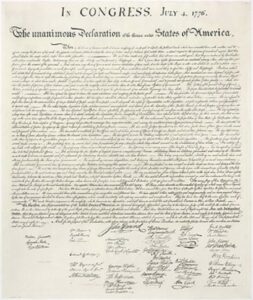 Today, February 16, is Presidents’ Day, a day celebrating the birthdays of George Washington and Abraham Lincoln, heroic authors of peace, and this year marks America’s Super-Centennial, the 250th anniversary of the Declaration of Independence. We give thanks for our country and its founding.
America’s remarkable history, formed by its many heroic presidents, reflects earlier foundations of faith and freedom, recalling Anglican Bishop Thomas Cranmer (1489-1556) and his Service of Morning Prayer. Many pray these words daily:
“O God who art the author of peace and lover of concord, in knowledge of whom standeth our eternal life, whose service is perfect freedom; defend us thy humble
servants in all assaults of our enemies; that we, surely trusting in thy defence, may not
fear the power of any adversaries, through the might of Jesus Christ our Lord. Amen.”
(1928 Book of Common Prayer).
As Christian novelists, we too author peace and concord. We invite the reader to enter the story through the characters they meet, experiencing words and deeds and thoughts that are both unique and universal. Some call this catharsis. Some call it identification. For a time, a few hours or a few days, the reader is fed with the author’s words. The reader finds comfort and meaning, validation and challenge. He enters the story, becomes a part of the conversation. In this way, fully drawn characters become lifelong friends, spending precious time, walking alongside the reader, sharing experience, offering hope, and even, indeed, love.
For we write that which we love. As lovers of the triune God, Christian fiction writers know and see God the Father, God the Son, and the God the Holy Spirit. We know and love all three, and in our stories, we hope to feed the reader with this peace that passeth all understanding.
And as our God is the author not only of you and me, but also of peace and concord, we thread this love through our plots, resolving tension and conflict, so that in the end, the reader trusts that peace will prevail. This meeting of spirit, this epiphany of reflection, creates a satisfying conclusion.
Presidents Washington and Lincoln also were formed and fed by Bishop Cranmer’s words of peace. They were steeped in this language of concord, of the sacred rights granted to all men by their God. In this year, the 250th anniversary of the Declaration of Independence, we recall the phrase,
“We hold these truths to be self-evident, that all men are created equal, that they are
endowed by their Creator with certain unalienable Rights, that among these are Life,
Liberty and the pursuit of Happiness…”
These truths were self-evident, for this was the heritage of the Founders, the Judeo-Christian tradition of love, peace, and concord. It was this history that informed America and civilized the West, for our God of love proclaims laws that create order among our warring tribes. He separates the wheat from the chaff, the sheep from the goats, drawing borders and boundaries through our lands, through our lives, and through our hearts.
I considered this Christian heritage in my sixth novel, The Fire Trail (Simon & Schuster/Histria, 2016), in which a grad student researches the history of Berkeley and the university, as characters search for peace in a world of crime and chaos. The fire trail, running through the Berkeley hills, becomes a symbol for the border dividing barbarism and civilization, conflict and peace, tribalism and democracy.
And so the story of Washington and Lincoln is the story of truths recalled and promised. Washington fought in the Revolutionary War, reading the Declaration to his troops, and was elected our first president; a century later Lincoln led the North against the South in the Civil War, freeing the slaves. These brave men embodied Bishop Cranmer’s prayer of peace and concord.
Just so, as Christian authors, we embody these truths in our stories, reaffirming unalienable rights endowed by our Creator, so that all might know peace, now and forever, in this life and the next.
 Christine Sunderland has authored seven award-winning novels: Pilgrimage, set in Italy, Offerings, set in France, Inheritance, set in England, Hana-lani, set in Hawaii, The Magdalene Mystery, set in Rome and Provence (all Oaktara), The Fire Trail (Histria), set at UC Berkeley, and Angel Mountain (Wipf and Stock), set on Mount Diablo, east of Berkeley. She is currently submitting The Music of the Mountain, about life and death and life again. She is a member of the Anglican Province of the King. Visit Christine at www.ChristineSunderland.com (website and blog), Facebook, and LinkedIn.
Comments 1
Chris, so happy to learn you are able to continue your good work. I look forward to The Music of the Mountain.
Carolyn Croft