
by Janice Haburn Shober
How would you write a new ending to your book?
This question arrived in my inbox when an editor said, “I don’t like your ending. Change it.”
Certain scenes are crucial to a book, and the ending is one of them. I can recall endings to many of the multitudes of books I’ve read, even if the actual plot has become hazy. Other scenes—whether joyful, tragic, or shocking—stick with a reader long after the last page. 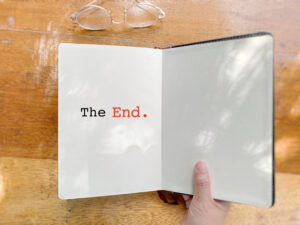
One scene that still lingers comes from a mystery series where the main detective’s wife—a favorite character—was killed by a stray bullet. It nearly ruined the series for me. The detective spent the next couple of books adrift in grief.
With that in mind, I knew my final scene mattered a great deal. So, I set about working through my editor’s feedback. My book had come a long way. The pre-published book for women has a life challenge and a spiritual challenge. A podcaster sets out on an island adventure to find her next winning program. Her peace, along with faith, has long since evaporated. Can she mount a life rescue for herself and her son in this idyllic setting? To wrap up this story in a way that matched the story challenge, here’s the process I followed.
Is it preferred?
The first question was, “Do I agree—and do I want to write something new?” After a few days of mulling it over, I saw my editor’s point of view and gradually came around to her conclusion. A new final would fit the genre better—women’s contemporary fiction calls for a heart-felt warm wrap-up. The decision was made. Decision-making styles vary—some decide quickly, others might resemble that wall sign I saw recently: I make decisions like a squirrel crossing the road. Let’s hope that’s not true.
Is it possible?
Most of the time, a new approach is possible—it’s just a matter of how much work it will take. Will it require combing through the entire manuscript? Will I have to rearrange my schedule to fit it in? In my case, the change would ripple into future series books but wouldn’t undo the current story. I knew it was possible and that I had the time.
Is it process-limited?
Since I was building on an existing manuscript, I could work within the framework of events and conversations already on the page. That made it easier to shape a new ending without starting from scratch.
The Outcome
Finally, I sat down at my computer, deleting and adding until the new chapter emerged. I adjusted my main character’s perspective and decision-making process—and it came together smoothly. The ending made me smile; it was so heart-felt.
The bonus? This change raised bigger questions for me, not just about my writing but about life: What is the desired “ending” to other challenges I’m facing?
What might need to be viewed differently, built on, or acted on to create that better outcome?
In the end, I was glad for the challenge. I now prefer my new ending—and the questions it inspired feel worth keeping.
 Janice Haburn Shober writes from Wisconsin, with a hubby, no pets, and a backyard full of flowers. When not at her computer, Jan can be found diving through books or pondering what’s up with her adult children and her grandchildren. She balances her manuscript stack with work in religious radio. Reach Jan Instagram @janicehaburnshober, or on her website.
Comments 1
Thank you for sharing your insight into how to write an ending, Janice!